A Sailor's History of the U.S. Navy by Thomas J. Cutler
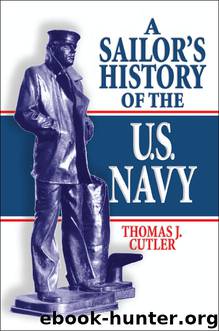
Author:Thomas J. Cutler [Cutler, Thomas J.]
Language: eng
Format: epub
Publisher: Naval Institute Press
Crisis on Yankee Station
Unless one consulted a nautical chart, it would be difficult to tell that “Yankee Station” was a place. It looked pretty much like many other pieces of ocean in many parts of the world when the aircraft carrier USS Forrestal arrived there in July 1967. Blue water stretched to three horizons and, on clear days when the frequent squalls did not get in the way, a distant coastline was visible to the west.
But it was a place nonetheless—a place in the Gulf of Tonkin, west of the South China Sea, where U.S. warships went to strike at enemy targets in North Vietnam. A place where aviation ordnancemen hefted live bombs and rockets to the wings and underbellies of attack aircraft, where enemy surface-to-air missiles were just over the horizon, where aviators too often did not return from sorties.
When Forrestal joined the carriers Oriskany and Bonhomme Richard on Yankee Station, U.S. forces had been fighting the war in Vietnam for two years. Sailors were by then conducting “brown-water” operations in the rivers and along the coasts of South Vietnam; hospital corpsmen were in the Central Highlands alongside their Marine brothers; SeaBees were building naval bases in key tactical positions; SEALs were conducting covert operations; and naval advisors of all rates and ranks were all over the war-torn country helping to build the South Vietnamese navy out of the remnants left behind by the defeated French.
At the time of her arrival for her first combat tour, Forrestal was one of the largest ships in the world. Manned by five thousand Sailors, she was more than 1,000 feet long, as tall as a twenty-five-story building, and displaced more than eighty thousand tons. At four acres, her flight deck was longer than three football fields laid end-to-end, and she was 252 feet wide at her broadest point.
Yet she was a tiny airfield. All those impressive measurements meant little to Gerald Farrier and the other aircraft handlers who constantly struggled to move nearly one hundred big airplanes around on the crowded flight deck. With so many aircraft on board, it was an ongoing challenge to position the planes so they could be launched, recovered, refueled, rearmed, repaired, and otherwise maintained. Moving about Forrestal’s flight and hangar decks, one felt not her vastness, but her confinement.
Farrier had left his home in Batesville, Arkansas, fourteen years before to serve in the U.S. Navy. His career had so far been a successful one. He had risen steadily as an aviation boatswain’s mate and, at the age of thirty-one, he was a chief petty officer with serious responsibilities. Among his many duties in Forrestal, he was in charge of Repair Eight, the highly trained team of Sailors who would respond in case of a plane crash, a fire, or some other emergency on the flight deck. He was responsible not only for multi-million-dollar aircraft but for the lives of his shipmates as well. On 29 July, just five days after Forrestal’s arrival on Yankee Station, that responsibility was about to become very real.
Download
This site does not store any files on its server. We only index and link to content provided by other sites. Please contact the content providers to delete copyright contents if any and email us, we'll remove relevant links or contents immediately.
| Africa | Americas |
| Arctic & Antarctica | Asia |
| Australia & Oceania | Europe |
| Middle East | Russia |
| United States | World |
| Ancient Civilizations | Military |
| Historical Study & Educational Resources |
The Radium Girls by Kate Moore(12093)
100 Deadly Skills by Clint Emerson(4972)
Rise and Kill First by Ronen Bergman(4838)
The Templars by Dan Jones(4733)
The Doomsday Machine by Daniel Ellsberg(4545)
The Rape of Nanking by Iris Chang(4255)
Killing England by Bill O'Reilly(4042)
Stalin by Stephen Kotkin(4004)
Hitler in Los Angeles by Steven J. Ross(3978)
12 Strong by Doug Stanton(3575)
Hitler's Monsters by Eric Kurlander(3385)
The Code Book by Simon Singh(3250)
Blood and Sand by Alex Von Tunzelmann(3240)
Darkest Hour by Anthony McCarten(3161)
The Art of War Visualized by Jessica Hagy(3043)
Hitler's Flying Saucers: A Guide to German Flying Discs of the Second World War by Stevens Henry(2777)
Babylon's Ark by Lawrence Anthony(2718)
Tobruk by Peter Fitzsimons(2559)
The Second World Wars by Victor Davis Hanson(2554)
